

SEAMLESS TRANSITION THROUGH EXPERT OVERSIGHT
The Roadmap
Moving to Spain works best in the right order: tax first, then residency, then property. These are the eight steps we take every client through.
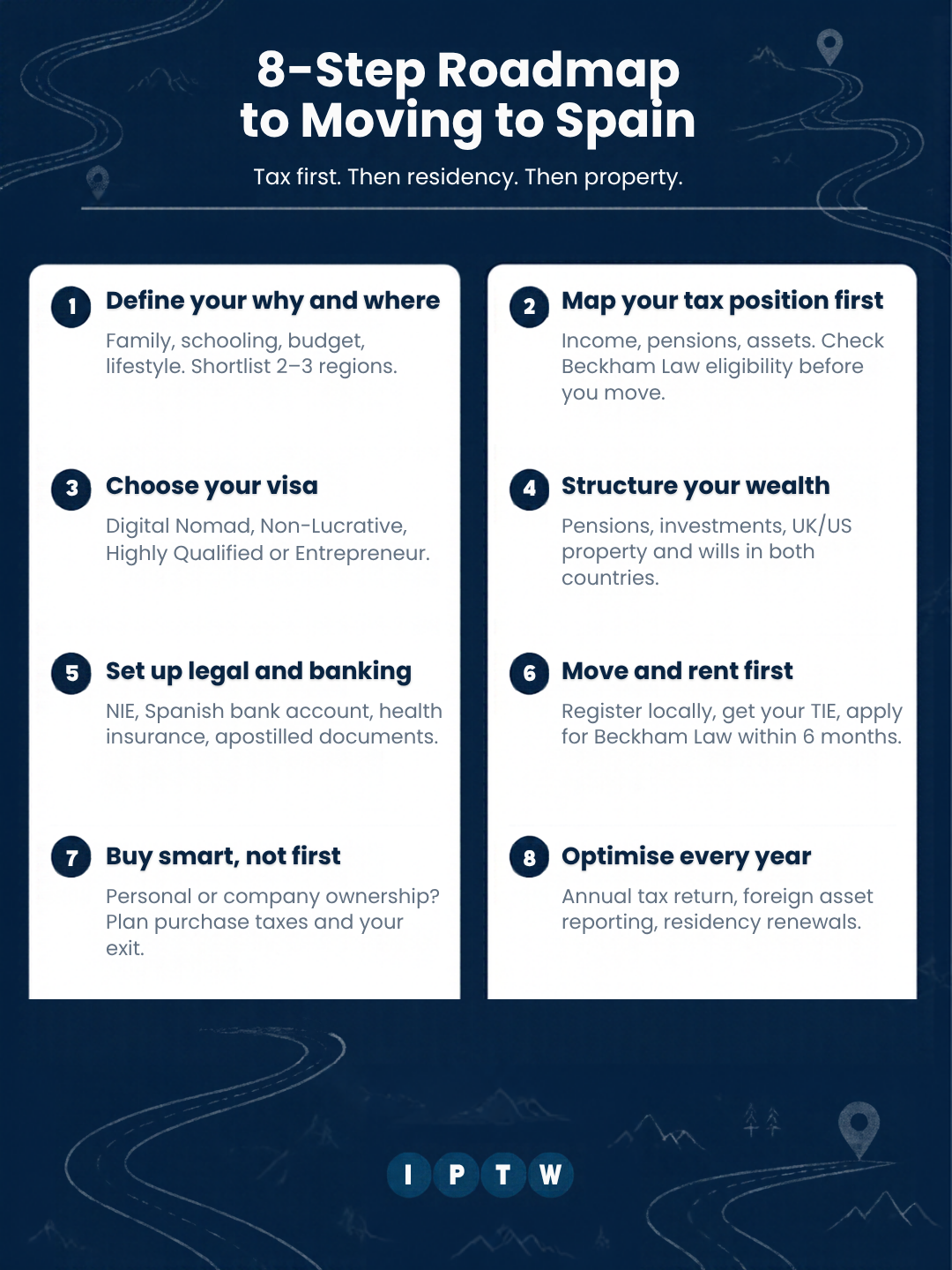
Step 1. Define your why and where
Define your why: What is driving the move: work, money, family or lifestyle? Then list what you will not compromise on, such as schooling, healthcare and climate.
Choose your where: Compare two or three regions of Spain on cost of living, flight connections, schools and regional tax differences.
Your first task: write down your three non-negotiables for life in Spain.
"Lifestyle-led relocation is only successful when paired with long-term legal and tax planning." – Alex Martin, Founder of IPTW
Step 2. Map your tax position first
Before you choose a visa: we review your income, pensions, investments and property in both countries, so the plan is in place before you arrive.
The 183-day rule: spending more than 183 days a year in Spain normally makes you Spanish tax resident. We plan your arrival date around it.
The Beckham Law: qualifying new residents can pay a flat 24% on Spanish employment income up to €600,000 a year, with most foreign investment income kept outside Spanish tax.
Checklist: Are you eligible for the Beckham Law? Do you have foreign assets to protect?
Step 3. Choose your visa
Digital Nomad Visa: for remote workers employed by or freelancing for companies outside Spain. Minimum income of around €2,849 a month in 2026.
Non-Lucrative Visa: for retirees and people living off savings or passive income. You need around €28,800 a year, plus €7,200 for each family member. You cannot work in Spain on this visa.
Highly Qualified Professional Visa: for people with a job offer from a Spanish company that meets the salary threshold.
Entrepreneur Visa: for founders with an innovative business plan approved by the Spanish authorities.
Please note: the Golden Visa (residency through property investment) closed in April 2025.
"Residency is more than paperwork – it's your gateway to a tax-efficient lifestyle."
Step 4. Structure your wealth
Pensions and investments: UK pensions, US 401(k)s, dividends and business income are taxed differently in Spain. We decide how each should be held before you become resident.
Property you leave behind: whether to keep, let or sell your UK or US property, and how the rental income will be taxed.
Wills and inheritance: wills in both countries, planned around UK or US inheritance tax and Spanish inheritance tax.
Wealth tax and reporting: we plan ahead for Spanish wealth tax and the Model 720 foreign asset declaration.
Step 5. Set up legal and banking
Paperwork: NIE number, Spanish bank account, private health insurance (where your visa needs it), and apostilled and translated documents, all prepared in the right order.
Checklist before you move: book your NIE appointment, arrange health insurance and secure a short-term rental contract.
Step 6. Move and rent first
Rent before you buy: test the area and build a local banking history before committing to a purchase.
Register locally: register on the padrón at the town hall and collect your TIE residency card.
Beckham Law deadline: if you qualify, you must apply within six months of registering with Spanish Social Security.
On-the-ground support: we help with NIE, insurance and school enrolment.
Step 7. Buy smart, not first
Ownership: buy personally or through a company (a Spanish SL or a foreign holding), depending on your tax position and your family.
Plan the taxes: purchase taxes, rental income, capital gains and your eventual exit, all planned before you sign.
Finance: Spanish bank mortgages, international private banks or cash purchases.
Completion: we manage due diligence, the arras (deposit) contract, the notary deed, land registry, and utility and tax set-up.
Reminder: a home is personal; its ownership structure should be strategic.
Step 8. Optimise every year
Annual tax return: your Spanish income tax return (Renta), reviewed each year for savings.
Foreign asset reporting: the Model 720 declaration if you hold more than €50,000 abroad in any one category (bank accounts, investments or property).
Renewals: residency card renewals and wealth tax, kept on time so nothing is missed.

Not sure where you stand?
Take our free 3-minute quiz to find out
Contact Us
IPTW Consulting helps clients from around the world obtain residency and bring their vision to reality. Contact us to arrange a free initial consultation